School of Nursing, Department of Nursing Professor Sachiko Shimizu Areas of specialization: Nursing management, health services research (HSR), fundamental nursing
Improving “Dandori” Skills What Type of Learning Program Helps Improve the Quality of Nursing Care?
The need for learning the “dandori” for nursing care
The current situation is that university education focuses on acquiring knowledge and skills, and there are almost no opportunities to learn “dandori for work,” which are skills required on-site. If new nurses could efficiently and systematically learn the “knowledge from experience” that skilled nurses have, the quality of nursing care would improve and the operations of the entire medical team would most likely run more smoothly. Professor Shimizu has been conducting research that focuses on the “dandori” for nurses, a topic with limited case studies globally. She has made it her life’s work to establish an effective learning method.
“Nursing philosophy” has a significant impact on “dandori”
Before starting her research, she first clarified the concept of “dandori.” It entailed the work of unraveling each aspect one by one, such as what does “dandori” consist of and what is it affected by. Research developed from operation management (goal setting, scheduling), operations execution (handling multiple tasks), operations improvement, to risk management. “It became clear that a nurse’s ‘dandori’ is greatly affected by his or her nursing philosophy and I thought that was very interesting,” she said, looking back. “While interviewing nurses, we noticed that some of them expressed some resistance toward ‘dandori’ since they understood the word to mean something like ‘getting the work done quickly.’ But, ‘dandori’ improves productivity by working efficiently and brings about psychological stability by freeing up more time. As a result, it leads to a creative job that has a positive impact on the patient, the nurse themselves, and the team as a whole,” she explains.
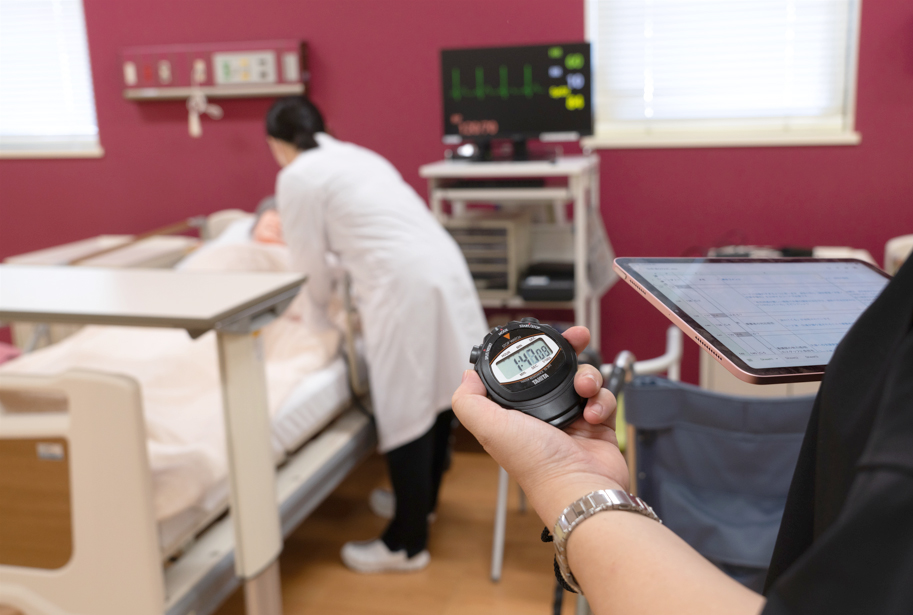
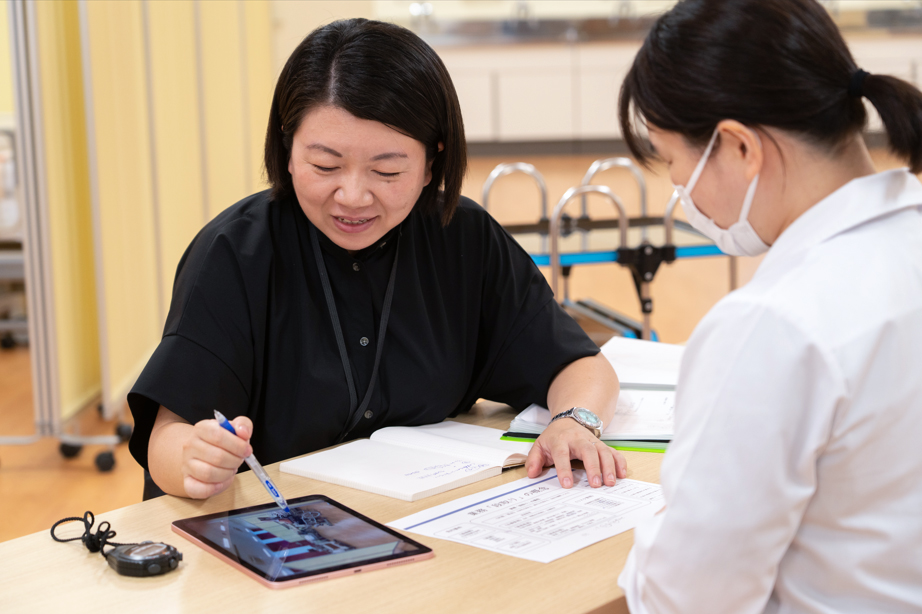
Measuring a nurse’s judgment during multitasking simulations. Evaluating the impact on “dandori.”Conducting interviews to learn about how “dandori” is carried out at the nursing workplace.
Creating a learning program for new nurses
Continuing their interviews of the nurses, they verified the process of how skilled nurses were carrying out “dandori” and also how new nurses should acquire “dandori” skills. Currently, she is involved in creating a learning program based on the knowledge gained from these interviews.
In this learning program, tasks are prioritized using the concept of “dandori.” At the nursing workplace, multiple tasks occur urgently and frequently. Students learn what to prioritize and how to lessen the occurrence of multitasking.
“For example, how should a nurse proceed when a ‘multitasking’ situation occurs where the nurse call rings for Patient B while they are assisting Patient A with toileting. To begin with, a skilled nurse would come up with a way to talk to Patient A and control the situation so that multitasking would not be necessary. In this way, we are designing our learning program so that new nurses can systematically learn the skilled judgment process (‘dandori’) that traditionally relied on ‘experience and intuition’.”
Working in collaboration with educational technology researchers and incorporating concepts of instructional design, she is currently designing a learning program that effectively uses the learner’s goal-action-evaluation cycle.
“After it’s completed, we intend for it to be used for the education of undergraduate students who are just about to graduate and new nurses who have just graduated. I hope that this program raises the level of ‘dandori’ skills and helps on-site nursing care to run smoother and elevates it to a higher quality. Furthermore, since it would be even more useful if we could build a database that nurses could access at any time, I’m hoping that we can collaborate with a hospital, corporation, university, or research institution so that we can develop one together.”
PROFILE
Graduated Division of Health Sciences, School of Medicine, The University of Osaka. Completed the Doctoral Program at Kobe University’s Graduate School of International Cooperation Studies. Doctor of Economics. Prior to assuming her current position, worked at the National Institute of Public Health, the Division of Health Sciences in the School of Medicine at the University of Osaka, and Kansai Rosai Hospital.