Faculty of Education, Department of Education Professor Lisa Uno Areas of specialization: Special-needs education, pediatrics, neurophysiology, medical care for children with disabilities
Building the Framework of a School Education System for Children with Medical Care and a Support System for School Nurses
School nurses under heavy pressure
Medical progress has saved children with severe illness, and the number of children with medical care at home such as sputum suction and tube feeding increased rapidly since the 2000s. As more children with medical care enroll not only in special needs schools but also in local elementary and junior high schools, the demand for “school nurses” who provide medical care at these local schools is also increasing.
In general medical institutions, nurses work in an environment where they collaborate with doctors and consult with other nurses. However, at schools, not medical institutions, nurses are often the only medical professional, making it difficult to consult other medical professionals immediately. Medical supplies are also limited, so school nurses feel immense pressure. Furthermore, since schools are places where teachers take initiative, the coordination between education and medical care can be difficult in some cases. Despite being indispensable at schools where children with medical care are enrolled, the low level of awareness of school nurses as a profession, makes it difficult to recruit new school nurses. In addition, some school nurses leave their jobs after only a short period, which has become a major challenge at the field level.
Dispatching experts to schools where children with medical care
Professor Uno is a pediatrician who specializes in medical care for children with disabilities and special-needs education. She began visiting schools with the Osaka Prefectural Board of Education in 2019, as a physician with expertise in both medical care and special-needs education. As a way to provide support to school education systems where children with medical care are enrolled as well as a way for preventing school nurses from quitting, Professor Uno participated in starting up the Osaka Prefectural Board of Education’s “Dispatching Experts to Support a School Education System and School Nurses for Children with Medical Care Attending Local Elementary and Junior High Schools” project and was involved in closing the partnership agreement with the Osaka Pediatric Association in dispatching experts for this project. Under this project, members of the Osaka Prefectural Board of Education and the municipal Board of Education, along with doctors, visit an elementary or junior high school requesting an expert visit. These experts listen to on-site concerns, observe classes and lunchtime, and advice to the school as medical care experts based on collaboration with the attending doctor, school doctor, family doctor, and home doctor.
“Children with medical care in local elementary and junior high schools are in a wide range of conditions and also include children with severe disabilities. For example, sometimes we are asked for advice on how a child can participate in an overnight trip unaccompanied by a guardian. We visit the school and talk with teachers, such as the school nurse, school administrators, class teacher, Yogo teacher, and special needs education coordinator, in order to understand and organize the situation.” says Professor Uno. This project received various inquiries, including a series of cases difficult to handle at school, such as “how can a child with a tracheotomy safely participate in swimming class?” and“how can students who need sputum suction take long bus rides?”However, in the surveys after this project, school nurses have answered that they were relieved since the school’s action plans became more specific. In this way, it can be seen that this project helps prevent school nurses from leaving their positions.
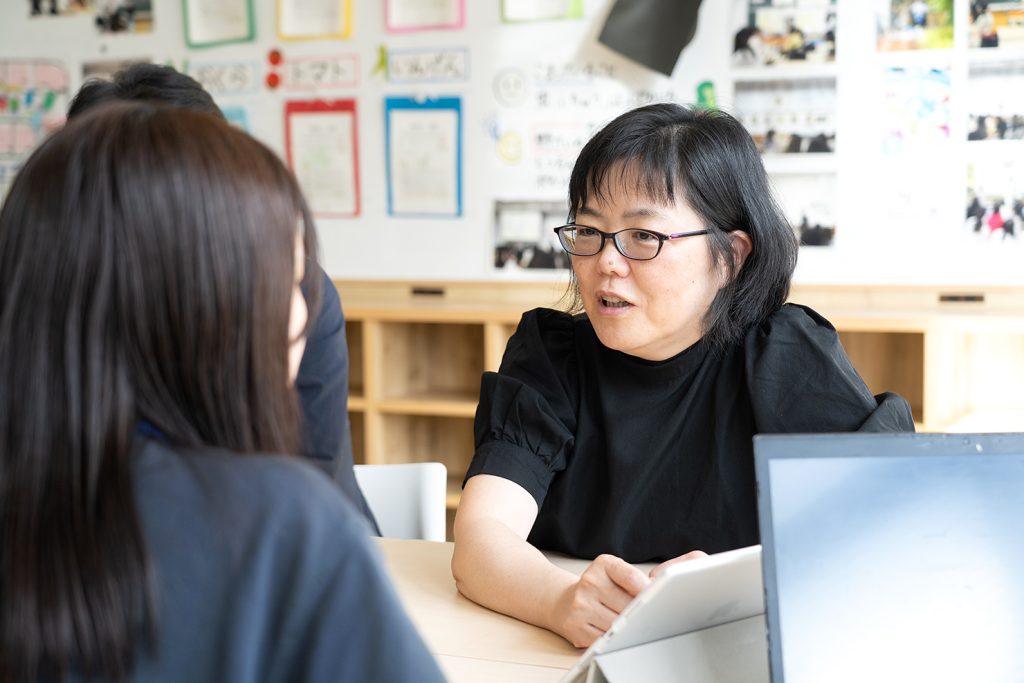
Working with the Osaka Prefectural Board of Education, providing specialized support at a school (*photo of a reenactment, not an actual visit)
Striving to expand the support system and nurture leaders
Medical care at schools continues to become more complex, year by year. In order for children with medical care to have a safe and meaningful school life, meticulous coordination among the parents, school faculty and staff, school nurse, and attending doctor is necessary. Professor Uno points out that “what’s most important is that the child and their parents can make decisions about their future and life path.” “In some cases, a doctor doesn’t have a complete picture of what the child is doing at school. Therefore, through the Osaka Pediatric Association, we share information with doctors such as how to write instructions that are easy to implement at school. While for school nurses, we try to give them more specific advice such as effective ways to ask doctors questions and good ways to communicate the situation on-site, so they are able to work with more confidence. Going forward, I hope to exchange ideas with persons in charge of support systems in other prefectures and also participate in research on nurturing leaders so that school nurses can work even more efficiently.”
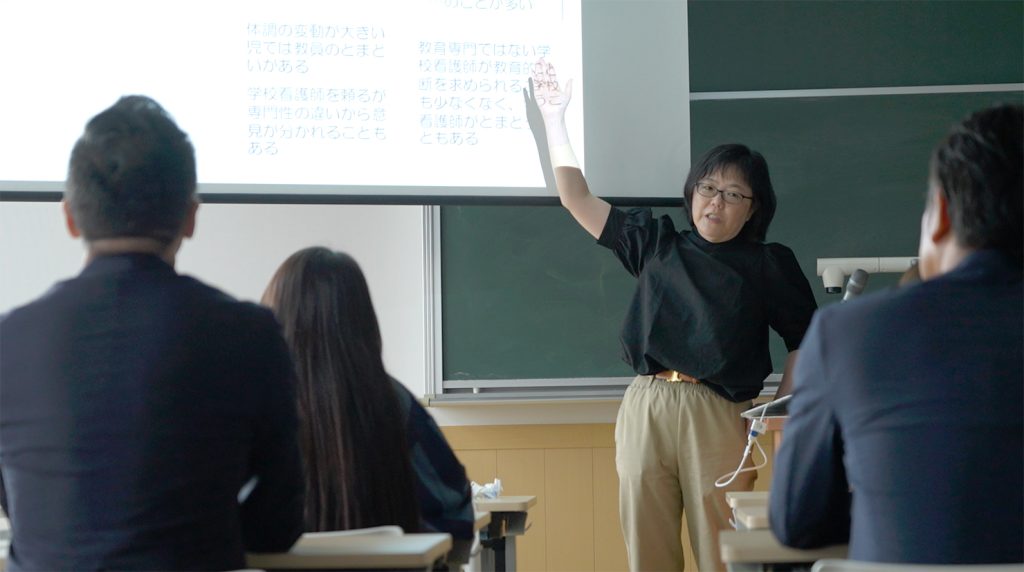
Conducting practical training for school nurses to nurture future leaders
PROFILE
Completed Doctor Course, Neurophysiology, Graduate School of Medicine, the University of Osaka. Research theme included the diagnosis of developmental disorders and expansion into education, childcare, and rehabilitation, as well as building an education and childcare system for children requiring medical care. As a physician with expertise in both children requiring medical care and special-needs education, she continues to make school visits, give lectures and conduct training sessions while lecturing at the university and conducting research.