Department of Applied Music, School of Music Associate Professor Chie Ohsawa Areas of specialization: Psychology of music, performance science, music education
Overcoming the “Talent” Barrier with Science: A Researcher’s Mission to Clarify the “Tacit Knowledge” of Keyboard Performance
Attempting to unravel the long-standing mystery of acquiring keyboard-playing techniques.
People tend to attribute the mastery of playing an instrument to “talent” and “sense.” Having once seriously studied piano performance and experienced the difficulties of acquiring the skill, Associate Professor Chie Ohsawa moved on to researching the mechanisms underlying keyboard performance skills.
For example, when a player reads sheet music, their hands and fingers quickly move to the correct keys. Despite its importance, much of this mechanism remains largely unknown, with little established knowledge to provide clear direction for learners. Building a logical, objective theory based on this mechanism would provide significant advantages for both performers and instructors. Describing in an understandable way how experts who “tacitly know how to do it” actually perform and providing knowledge and methodologies to overcome challenges faced by players and teachers—this is her mission.
What clues help performers find the correct position of the keys to play?
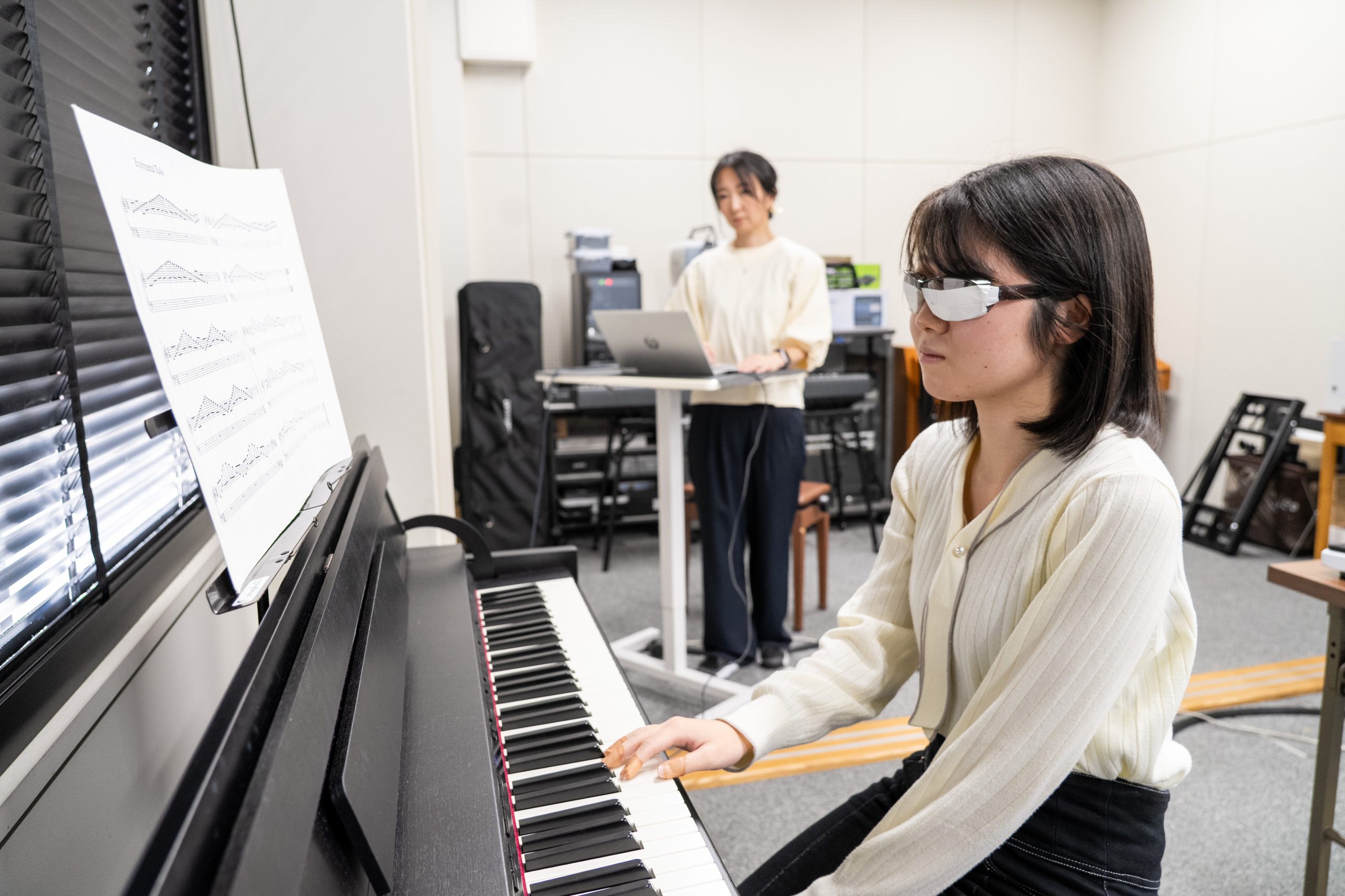
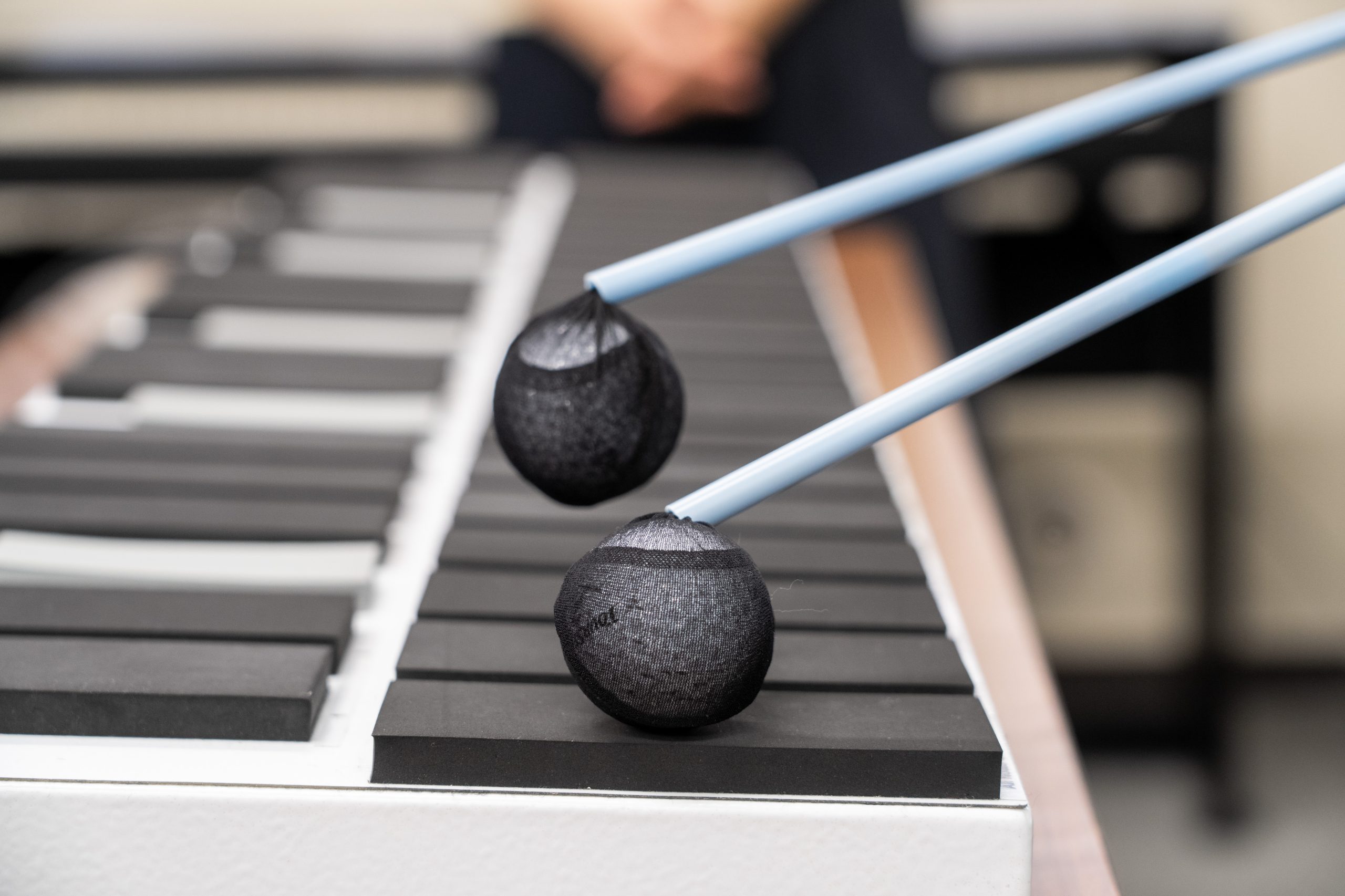
A keyboard instrument performance is made up of the continuous action of striking keys that correspond to the intended notes at the appropriate timing. To clarify how players reach the keys to play the notes they want, she began experiments to investigate the role of sensory (visual and auditory) information during piano performances. Specifically, she had participant pianists play various melodies while applying audio-visual constraints, such as blindfolding or muting the digital piano during performances. She measured the extent to which these restraints interfered with the participants’ performances. Results revealed that even sequences of small leaps require the pianists to control key strikes by ascertaining key positions from moment-to-moment visual information. It also demonstrated that auditory feedback plays a vital role in correcting such errors. Next, she developed, together with her students, experiments on other types of keyboards where players had to either hold a smaller keyboard, such as a keytar or position themselves in front of the larger keyboard, such as an electronic marimba, and had to perform with restrictions on somatic sensations (touch, sensations in muscles and joints, tactile responses, etc.), such as having plastic tips on their fingers or using modified mallets. For keyboard instruments of different sizes played in various postures, vision commonly played an important role, and the support of the tactile and somatic senses, as well as hearing, could not be ignored.
Investigating the effects of restricting vision, hearing, and touch on the digital piano performance.
Conducting an electronic marimba experiment using custom-designed mallets.
Scientific insights into skill breakthroughs and social application.
From her own experience, she emphasizes that “The key to acquiring musical skills should be rooted in objective data, rather than being dismissed as a mere matter of ‘talent’ and ‘sense,’ or ‘effort’ and the ‘amount of practice’. That’s why clarifying what mechanism in the player leads to a breakthrough improvement is necessary.” The findings from this research will support ideas for better practice methods and are also what learners struggling to acquire skills and instructors struggling to teach diverse students are craving.
Therefore, it is essential to share these insights in an accessible way—not only through lectures and publications but also via online platforms and specialized media outlets for the music industry and local governments.
Also, to analyze complex performance data and build a control mechanism model, collaboration with research institutes and researchers with deep expertise in music information processing, mathematical modeling, and advanced statistical analysis is indispensable. She is actively seeking researchers who can apply new analytical methods and technologies to her laboratory’s experimental data and findings.
“Going forward, I would like to broaden the scope of my research to include performance control in instruments beyond keyboards, and the mechanism of skill transfer across different instruments.”
PROFILE
Graduated from the Music Major, Junior High School Teacher Training Program in the Faculty of Education at Shinshu University. Completed the master’s Program in Music Education (Subject Pedagogy) at the Graduate School of Education, Shinshu University. After two years of working as a public high school teacher in Nagano Prefecture, completed the doctoral coursework at the Graduate School of Modern Society and Culture, Niigata University. She later earned a Ph.D. (Education) at the United Graduate School of Education, Tokyo Gakugei University, with a dissertation. Her previous positions include a research assistant at the Bio-mechanics & Motor-control Laboratory, Graduate School of Medicine, Osaka University; a research fellow at the Yamaha Music Research Laboratory; a JSPS Postdoctoral Research Fellow in the Faculty of Music, Kyoto City University of Arts; and a researcher at the Kokoro Research Center, Kyoto University.