Department of Human Environmental Sciences, School of Human Environmental Sciences Yuko Mizuno, Associate Professor Areas of specialization: Living environment planning, urban planning, community development, housing policy, housing studies
Creating a Sustainable City Utilizing the Massive “Housing Stock” as an Asset
Transforming the legacies of the high economic growth period into local hubs for the next generation
Japan’s urban areas are facing a major turning point right now. The residential complexes and new towns planned and developed by various public and private entities to resolve the housing shortage in urban areas during the period of high economic growth were once the symbols of aspirational modern living. Now, however, more than half a century later, issues such as the deterioration of buildings and aging residents are becoming apparent in various places.
These types of planned residential areas are the subject of Associate Professor Yuko Mizuno’s research. Her research focuses on housing complexes (“danchi”) in particular because issues are more likely to become pronounced there. Since a large number of residences were provided over a short period of time, residents who moved in at the same time are aging all at once and the deterioration of buildings progresses on a large and concentrated scale.
The main purpose of past housing development was “providing housing,” but she points out that “amid changes like population decline and economic downturn, the revitalization of housing complexes and new towns is expected to contribute to the revitalization of the entire surrounding area, not just the residential area.” The revitalization of the residential area is mainly conducted by various entities, including residents, municipal governments, companies and business operators but focusing on the cooperation and roles among entities, she continues to search for how the maintenance of hardware like buildings and spaces, and intangible initiatives like community building should be linked together.
Current location of large-scale residential area as seen in the Mukogawa Danchi(housing complex)
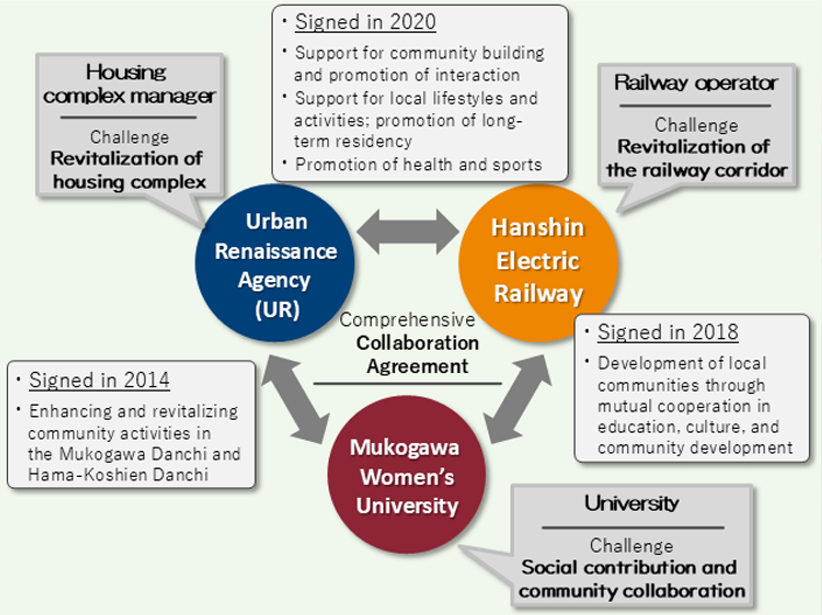
One of the main subjects of her research is the “Mukogawa Danchi,” one of the largest housing complexes in western Japan. Since the 2000s, the Urban Renaissance Agency (UR) has proactively promoted housing complex revitalization efforts, and she has been conducting ongoing research in collaboration with UR and Hanshin Electric Railway.
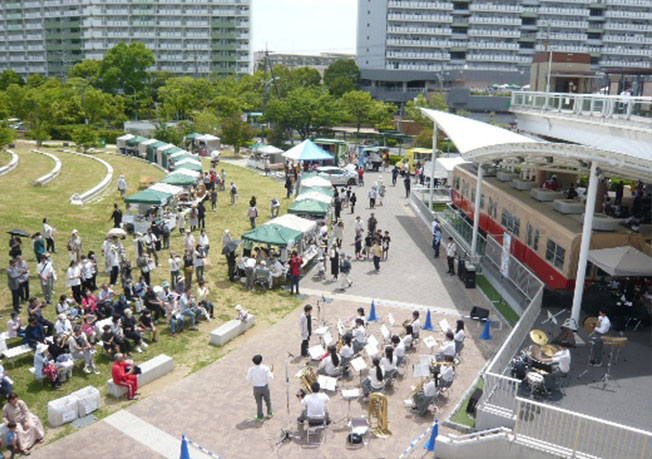
She is verifying what types of revitalization efforts would contribute to the well-being of housing complex residents and surrounding residents by quantifying residential satisfaction and well-being through questionnaire surveys. Especially in the Kansai area, the historical background that railway operators have led development along their railway lines cannot be ignored. Railway companies have not simply run trains, they have shaped the life infrastructure along the railway lines. Under these circumstances, Hanshin Electric Railway became actively involved in the revitalization efforts of the Mukogawa Danchi, which is a housing complex located along the railway line, and in the summer of 2021, the new lawn area was created here at the Mukogawa Danchi. Under the comprehensive cooperation agreement signed by UR and Hanshin Electric Railway, an actual Hanshin railway train car (“akadosha,”) was transferred to UR and was installed and reused as a symbol in the new community space. ”Akadosha” was remodeled so it could be used as a meeting place, and events that promote interaction with local residents such as open markets are held regularly in the lawn area which is starting to function as a place to create connections between people across generations and positions. These efforts have renewed the image of the housing complex and have also had a positive impact on the surrounding area.
This perspective is also reflected in practice at another neighboring UR Hama-Koshien Danchi . Amid the rebuilding project that has been underway for over 20 years at this housing complex, the university, the local community, and local residents have been working on collaborative projects. Various activities have been carried out so far with students becoming involved with the local area through surveys and studies and repeatedly exchanging opinions with the local community. Activities include providing support for initial initiatives in starting a kitchen garden with the purpose of community building through vegetable cultivation, operating community spaces using vacant stores, and holding “candle nights” with the cooperation of residents and students to light up the housing complex. These efforts were attempts to redefine housing complexes as a “place” to foster relationships between people, not simply just a living space.
Future community development fostered through industry-academia-government collaboration
The success of housing complex revitalization depends on whether it continues to be a desirable place to live. Her research is making a real-world impact by feeding back academic knowledge to the business operators.
The aim is not just to renew old buildings, but to create a society where residents’ quality of life improves and vitality spreads throughout the region. She shared her future vision, saying “Going forward, I would like to broaden my horizons beyond the framework of housing complexes and new towns, and look at community development over a wider area and along the entire railway line, and also the sustainable regeneration of residential areas through the involvement of diverse entities.”
This research will only succeed through collaboration among industry, academia, and government. Deepening collaboration through external funding and joint research will make more detailed data analysis and proposals of empirical measures possible. By combining it with the objective evidence accumulated through years of research, the knowledge on the redevelopment of housing complexes using the Mukogawa Danchi as a model should help solve the problems faced by suburban residential areas nationwide.
Case study of the partnership between the Urban Renaissance Agency and Hanshin Electric Railway.Revitalized community space at the Mukogawa Danchi with the “akadosha” as its symbol.
PROFILE
Current position after working as an assistant, an assistant professor, and a lecturer at Mukogawa Women’s University’s Department of Human Environmental Sciences. Ph.D. (Human Environmental Sciences). Main research themes include the regeneration and inheritance of planned residential areas, the role of the entities and leaders involved, etc. Publications include “Coexistence of the City Center, Town Center, and Suburbs” (Koyo Shobo, joint work), “Railroads and Suburbs” (Kajima Institute Publishing Co., Ltd., joint work), etc.