School of Social Informatics, Department of Social Informatics Associate Professor Naoko Enami Areas of specialization: Perceptual information processing, pattern recognition
Optical Technology Pioneering the Future of Cultural Heritage: Passing Down the “Legacy of Human Endeavors” with Non-destructive Measurement
A new perspective to understand the reality of material deterioration
Cultural properties, such as stone architecture and traditional textiles such as kimonos that have been passed down through the ages are valuable indicators that convey our history and technology. However, over the course of many years, outdoor stone materials are exposed to wind, rain and ultraviolet rays as well as air pollution, while textile products are subject to fading and degradation. In both cases, deterioration steadily progresses. Once this type of deterioration starts, it cannot be reversed. The success or failure of preservation depends on whether “the current state” is accurately assessed at the right time.
With conventional measurement methods, there is the risk of damaging the cultural property materials from contact as well as the limitations of on-site use due to large equipment such as X-ray equipment. What is needed is “optical measurement technology” that can safely obtain material information non-destructively, without damaging the cultural properties. Associate Professor Naoko Enami stresses the importance of this field of research stating that “Technology that measures the progress of weathering in a high-resolution, non-destructive manner will become the basis for the long-term protection of cultural properties.”
Analysis of material properties based on optical information
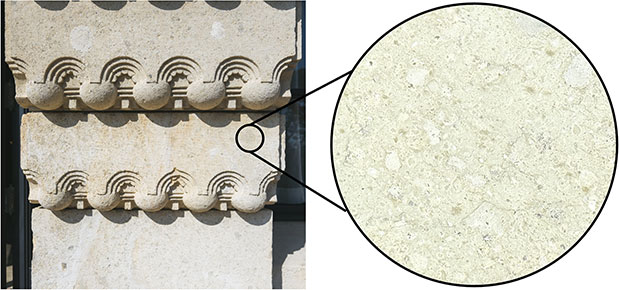
Currently, at the Enami Laboratory, under a joint research system with Tokyo Denki University and our university’s Department of Architecture, they are researching methods for analyzing the deterioration of stones and textiles using light reflection (spectrum). One of the properties targeted for this research is the stone material of Koshien Hall, the registered tangible cultural property which is also the school building for our Department of Architecture. Weathering of the outdoor stone for this facility has been confirmed, and the challenge is how to make a scientific assessment of the current state.
In this research, spectral signature is obtained using multiple optical sensors and by making that information correspond to the position as an image, they are building an environment where the composition occurring inside the stone can be “visualized” in detail (pixel level). They are aiming to scientifically identify the state of deterioration by obtaining high-resolution reflection characteristic data through this method of measurement. In the initial analysis, it was confirmed that there are clear differences in the spectra between different stone materials and they obtained the empirical evidence that materials can be classified non-destructively.
Furthermore, Associate Professor Enami is now focusing on how this ultra-precise color and material data obtained from the measurements can be used next.
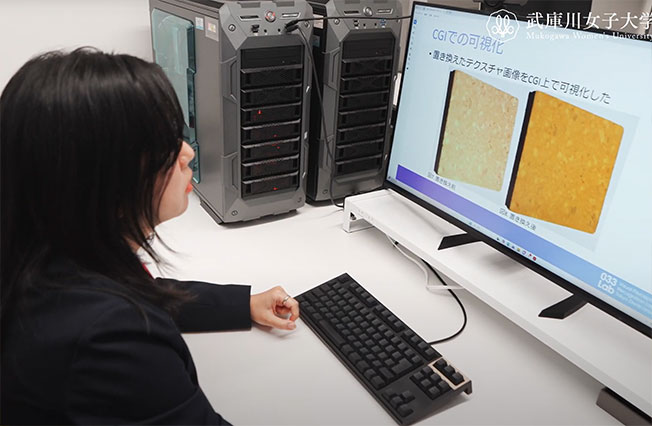
This data is being used in computer graphics (CG) for color settings and textures when creating three-dimensional objects. In this way, a “digital time capsule” that faithfully reproduces the color and texture of the material before deterioration can be completed. By visualizing the deterioration distribution of the materials in computer graphics, it becomes possible for experts to perform simulations for developing a restoration plan without having to touch the actual item. Additionally, realizing an exhibition method that allows audiences to experience the conditions as the people at that time would have seen them would ensure passing the “legacy of human endeavors” on to the next generation.
New foundation for preservation and utilization led by non-destructive measurement
The social value of this research is not limited to the field of cultural property protection. Non-destructive measurement and high-resolution data analysis technology, which is based on the camera and sensor technology that Japan prides itself on, is highly versatile.
It can be said that the value of this research in terms of real-world application is extremely large, as it is also expected to be applied not only in the field of cultural property protection, but in a wide range of fields including social infrastructure (road and bridge deterioration diagnosis), smart agriculture (crop health assessment), and car sensors.
In addition, as optical sensors are portable, they can also be used at ruins overseas and cultural heritage sites in developing countries, contributing to the protection of cultural properties on a global scale. Being able to perform non-destructive measurements even in environments where large equipment cannot be brought to the site is highly significant. It’s a technology that will open up new options for international cooperation.
In the future, by strengthening collaboration with museums and restoration organizations, the scope of research will likely expand even further. Associate Professor Enami aims to create a society that accumulates new data that will contribute to future preservation and utilization by accurately preserving the images and information of cultural heritages that are being lost digitally while visualizing conditions and changes that could not be grasped until now. Efforts to ensure passing the value of cultural properties and records of human endeavors on to the next generation will continue to deepen, centered on the technology to decipher light.
Tatsuyama stone is used as the stone material for Koshien Hall. The reflection of light is analyzed with an optical sensor to read the composition.The texture is reproduced using computer graphics based on the obtained spectrum data.
PROFILE
Completed the Doctoral Program in the Department of Information Processing at the Graduate School of Information Science, Nara Institute of Science and Technology. Ph.D. (Engineering). Having worked as an assistant professor and specially appointed lecturer at Kobe University and the University of Osaka, started working at Mukogawa Women’s University in 2018.