さらに独自のアイデアで研究を続け、大学内のpilot grant fundingを獲得した。2018年帰国し武庫川女子大学に入職。学生への指導のかたわら研究を続け、2022年度に科研費を獲得した。「教員としての多忙な業務はありつつも、この研究を何としても仕上げたいという気持ちでした」 「このプロジェクトは骨髄中のメカニズムを見ています。骨髄中には骨もしくは脂肪の生成に関わる幹細胞があり、何らかの刺激を受けて各々の細胞に分化します。加齢とともに脂肪の生成が増え、骨の生成が疎かになることは当時から知られています」 現在も続く研究では、閉経に伴うエストロゲン低下が骨髄または骨細胞内で標的としている転写因子の増加を引き起こし、破骨細胞の活性化や骨形成バランスなどに影響を与え、骨粗鬆症へ導くという仮説を立案。その検証のため、細胞やマウスを用いた機能解析や骨表現型の解析などを続けている。
Department of Food Sciences and Nutrition, School of Food Sciences and Nutrition Professor Teruyo Nakatani Areas of specialization: Functional Food and Culinary Science, Molecular Nutrition, Functional Physiology
Striving to Help Prevent Osteoporosis in Postmenopausal Women
Osteoporosis predominantly affects postmenopausal women
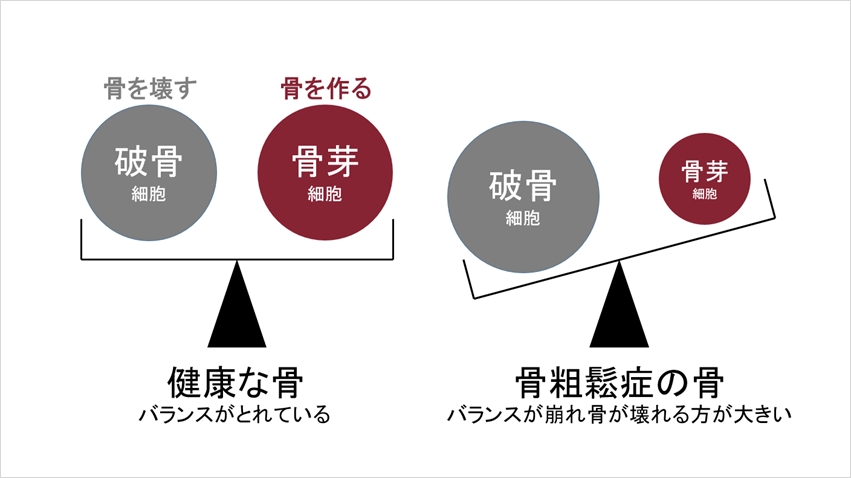
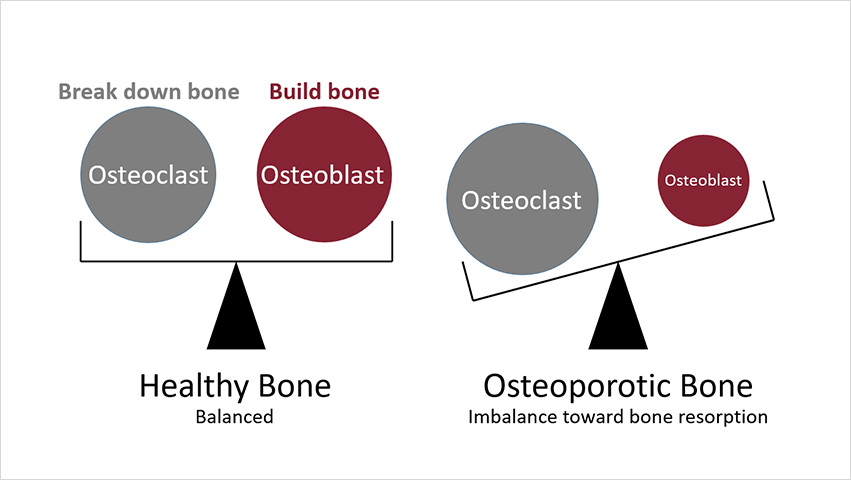
Osteoporosis is a disease where bone mass decreases and bones become brittle and prone to fractures. Currently, the estimated number of patients over 40 years old with osteoporosis in Japan is approximately 15.9 million, of which 11.8 million are women. The prevalence of osteoporosis is very high, especially in postmenopausal women, and it isn’t uncommon for bone fractures to cause patients to become bedridden. The secretion of the female hormone, estrogen, decreases after menopause. This decrease causes osteoclasts (breakdown of bone; bone resorption) to become overly activated, working faster than osteoblasts (bone formation), which causes a decline in bone density, which in turn, leads to osteoporosis. However, many aspects of the detailed mechanism remains unclarified.
Mechanism of osteoporosis
Investigating the mechanisms in bone marrow
During her research overseas, Professor Nakatani revealed that transcription factor MEF2C (myocyte enhancer factor 2C) contributes to the increased expression of enzymes involved in bone resorption by osteoblasts, and published a paper on the topic in 2017.
Furthermore, continuing her research with her original ideas, she was able to obtain pilot grant funding within the university. In 2018, she returned to Japan and started working at Mukogawa Women’s University. Continuing her research while teaching students, she obtained a Grant-in-Aid for Scientific Research for fiscal year 2022. “Although I was busy with my work as a teacher, I strongly felt that I wanted to finish this research no matter what.”
“This project looks at the mechanisms in bone marrow. Bone marrow contains stem cells involved in bone or fat formation, which differentiate into individual cells in response to a stimulus. It has long been known that with age, fat formation increases and bone formation slows down.” In her ongoing research, she hypothesizes that the decrease in estrogen due to menopause causes an increase in the transcription factors targeted within the bone marrow or bone cells and influences osteoclast activation and bone formation balance, which leads to osteoporosis. In order to verify this hypothesis, Professor Nakatani continues to perform functional analysis using cells and mice as well as bone phenotype analysis.
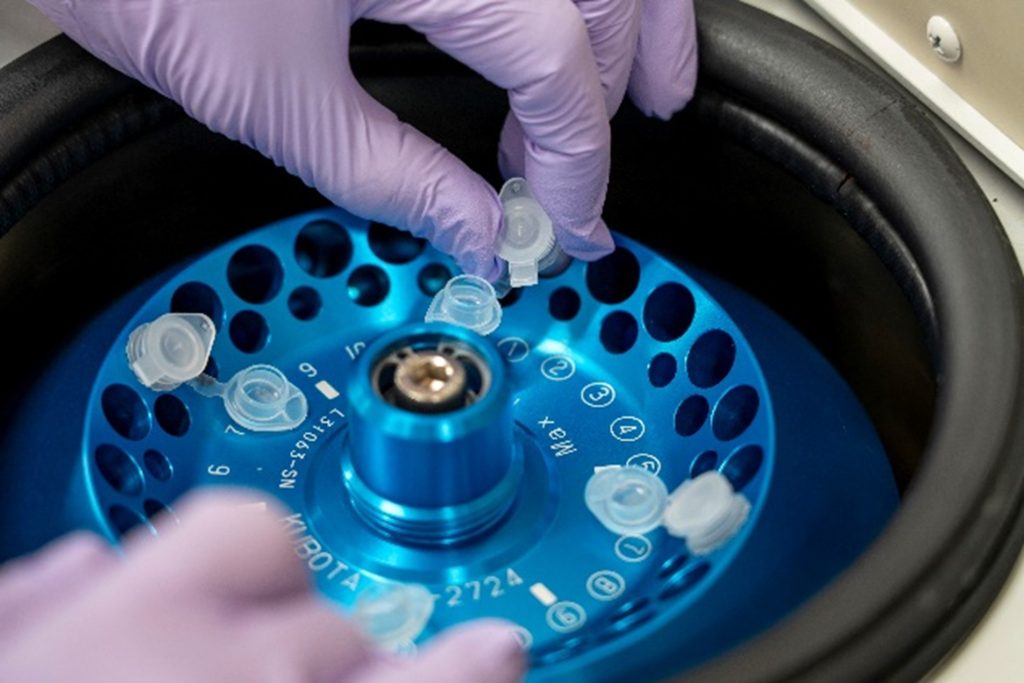
Preparing samples for gene expression analysis
I aim to prevent osteoporosis during the pre-disease stage
Professor Nakatani regards preventing the disease in its pre-disease stage as particularly important. She maintains that “if research doesn’t benefit people, it’s meaningless.” “I love thinking about how the various biological activities occurring inside our bodies are carried out and the mechanisms behind them. So, if it’s research related to clarifying such things, I’ll become completely engrossed. For example, the mechanism of how transcription factors bind to the necessary DNA to influence the human body is truly ingenious. Inside the human body, more things than we can imagine are happening. This extraordinary fact always amazes me. I want to be able to contribute to people through the findings of this type of research and I think that’s how it should be.”
If the mechanism of pathogenesis for osteoporosis is in fact, just as Professor Nakatani hypothesizes and the targeted transcription factors are involved, one aspect of the point of differentiation for each cell within bone marrow would be revealed and the prevention of osteoporosis in everyday life could become a reality in the future.
“What it actually is remains unclear. It may be food, exercise, or some other factor. But if we can find something in everyday life that leads to prevention, we can reduce the number of people who become bedridden from bone fractures.”
Going forward, Professor Nakatani is considering research that also takes into consideration the possibility that the targeted transcription factors are involved in bone diseases as well as other conditions, not only osteoporosis after menopause. “In order to push this research forward, I hope we’re able to conduct joint research with a university, research institute, or corporation that has the equipment necessary to analyze genetically engineered mice samples, and if possible, that also has technicians on staff. The key aspects of the research have already become clear, so support in producing research results that benefit people would be greatly appreciated.”
PROFILE
Completed the Doctoral Program at the Osaka City University Graduate School. Doctor of Philosophy. Dietitian.