Yuki Shigemoto, Lecturer Department of Psychology, School of Psychology and Social Welfare Areas of specialization: Depressive Rumination, Cognitive Behavior Therapy (Acceptance & Commitment Therapy)
Delving into the mechanisms of action for psychotherapy ―The forefront of psychological research
Re-examining support for depression by questioning “why it works”
Depression is one of the more common forms of mental disorders in present-day society. Depression is often comorbid with other mental illnesses, such as adjustment disorders and panic disorders. This casts a dark shadow on the individual’s life. Until now, the practice and research of psychotherapy have been limited to the application and verification of “psychotherapy packages,” effective sequences of psychotherapies packaged together. Because of this, the clarification of the mechanism of “why psychotherapy works” hasn’t been sufficiently researched.
Taking on this challenge is Yuki Shigemoto, who specializes in behavior analysis and relational frame theory. A thought pattern called “depressive rumination” is said to be one of the causes of depression. Her research aims to clarify the structure of this thought pattern. “Unless it’s clear why it works, it won’t lead to personalized treatment. With that in mind, I am reexamining depression from a relational frame theory perspective,” she explains.
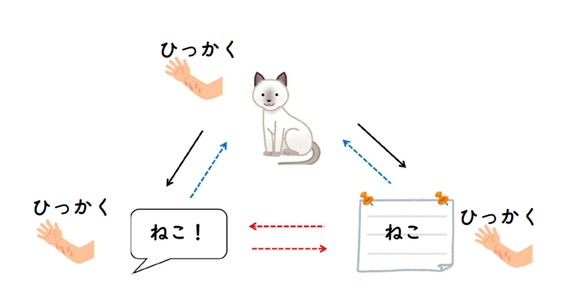
Relational frame theory is the psychological framework that connects stimuli, such as words and thoughts, to “relationships,” such as “same,” “different,” “large,” “small,” or “there is a causal relationship.” In the diagram above, “actual cat,” “cat as sound stimulus,” and “cat as textual stimulus” are connected as “same.” In this case, if the person experiences being scratched by an “actual cat,” they will remember the experience of being scratched just by being presented with the sound or textual stimulus.
Visualization of depressive thought patterns from relationships between stimuli
Ms. Shigemoto’s research is targeted at depressive rumination, that is, the “repetitive thought of continuously thinking about problems that can’t be solved even if you think about them.” In order to solve the problem at hand, people will “think” about how to resolve that problem. This method was extremely useful in the evolution of humans, so even when negative thoughts and emotions arise, people take the action of “thinking” in order to get rid of those thoughts and emotions. However, these negative thoughts and emotions can’t be eliminated through thinking, so the act of “thinking” continues and leads to depressive rumination.In the research up until now, it was assumed that people with depression had a thought process that was connected to a multitude of negative stimuli. In Ms. Shigemoto’s research, however, contrary to conventional findings, it has been found that there is a high possibility that people with depression actually have a thought process that is connected to too much “positive stimuli.”“It might be that many people struggling with depression may have positive hopes, such as ‘I want to be happy’ or ‘I want to be successful in my work’. Consequently, they may perceive negative thoughts as obstacles to happiness. Therefore, we may be able to implement more effective interventions by shifting the focus of psychotherapy from ‘removing the negative’ to ‘what is true happiness,’” says Ms. Shigemoto. In order to verify such hypotheses, she developed her own original Kanji Maze Technique as a measuring method and is building quantitative indicators to understand how participants are creating connections with stimuli.Furthermore, collaborating with researchers from other universities, Ms. Shigemoto is also working on applying cognitive behavioral therapy for depression during the perinatal period (pregnancy period to postpartum). In particular, they are developing psychotherapy that focuses on the relationship between postpartum depression and depressive rumination. They are in the stage of verifying its effectiveness.
Ms. Shigemoto independently developed the “Kanji Maze Technique.” The time it takes a participant to create jukugo (kanji compound words) is measured and that reveals the participant’s thought pattern.
Giving back to society, the knowledge for providing support
At the root of Ms. Shigemoto’s research is the philosophy of “wanting to support people.” “Education is about supporting students. Research is about supporting clients and clinical psychologists. And, about clinical psychologists contributing to supporting people. I want to hold dear this type of supportive cycle,” she says.
The final goal is the social implementation of the research findings. For psychotherapy to be covered by medical insurance, it is imperative to clarify not only the effectiveness of intervention but the “reason” for its effectiveness. Ms. Shigemoto is certain that verifying the reason “why a psychological approach works” will change the national system and lead to more people receiving the support they need in the future.
PROFILE
Graduated from Department of Humanities Psychology Major, Faculty of Literature, Ritsumeikan University. Completed of Master’s and Doctoral Programs, Graduate School of Psychology, Doshisha University. PhD (Psychology). Current position from 2022, after working as a lecturer at the Faculty of Clinical Psychology, Kyoto Bunkyo University. Also works as a part-time psychologist at Kyoto Daiwanoie (a children’s and baby’s home) and JOHNAN Corporation’s health counseling room.